China Top 10 Pull Out Faucet Hose Brands How to Change?

Time:2026-10-15 Author:Aria
0%

Replacing a pull-out faucet hose looks simple until water collects beneath the sink. This guide examines China’s top 10 pull-out faucet hose brands and explains how to compare them. It also answers the practical question: how to change a pull-out faucet hose without damaging the fitting, counterweight, or spray head. Brand reputation matters, but connector size, hose length, and material matter more. Even a premium hose can fail when compatibility is ignored.

Richard Trethewey, a licensed master plumber and plumbing expert, has said, “Water always finds the path of least resistance.” That principle applies beneath every kitchen sink. Before changing the hose, shut off both supply valves. Keep a towel and small bucket nearby. Take a clear photograph of each connection. This small step can prevent confusion later. Release the old hose gently, inspect the O-rings, and avoid forcing threaded fittings. Hand-tighten first. Then use a wrench carefully.

The comparison in this article considers brand availability, replacement support, connector design, and practical durability. It may not fit every faucet model. That is worth admitting. Some product manuals are vague, and older faucets may use uncommon fittings. Check the manufacturer’s specifications before ordering. A brand ranking can also be imperfect because prices and regional stock change. The safest choice is not always the most expensive one. It is the hose that matches your faucet and survives repeated movement without kinking, leaking, or pulling against the spray head.
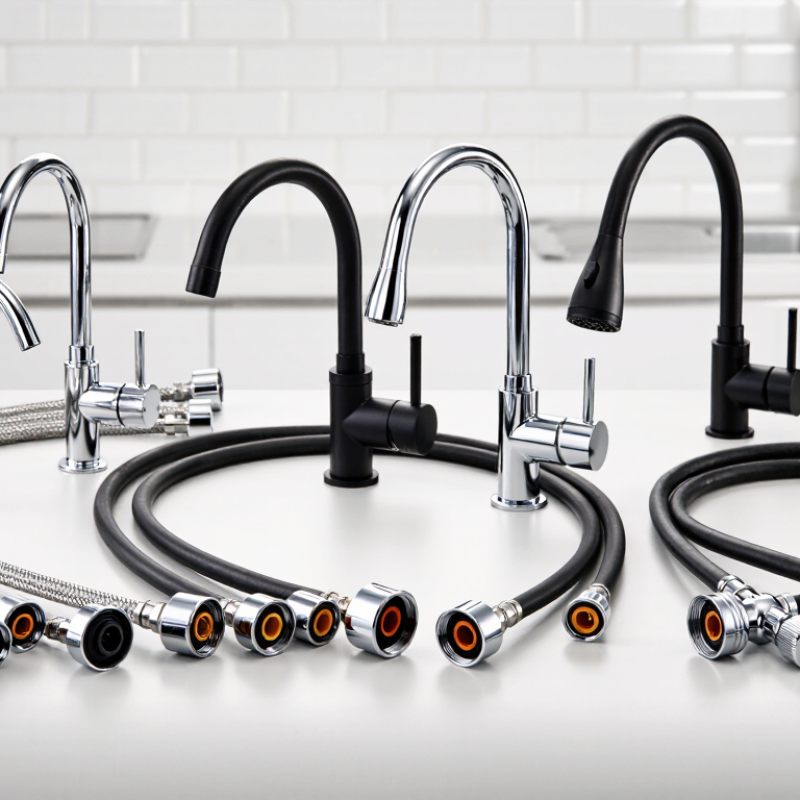
China Top 10 Pull Out Faucet Hose Brands How to Change?

Pull-Out Faucet Hose Basics: Materials, Sizes, and ASME A112.18.6 Standards

Pull-Out Faucet Hose Basics: Materials, Sizes, and ASME A112.18.6 Standards

A pull-out faucet hose works under repeated bending, twisting, and water pressure. Common constructions use braided stainless steel over EPDM or reinforced polymer tubing. EPDM handles hot water well. Polymer hoses often feel lighter and slide more quietly through the spout. The choice is not always obvious. A softer hose may kink less, but it can resist retraction after years of use.

Sizes vary by connection, length, and end fitting. Many residential hoses measure about 59 to 79 inches, but length alone does not confirm compatibility. Check the faucet-side connector, weight attachment, thread profile, and sealing washer. A replacement hose should match the original internal diameter. Even a small mismatch can reduce spray performance or create leakage beneath the sink. Measure twice.

ASME A112.18.6 covers flexible water connectors and evaluates construction, pressure resistance, and durability requirements. It is an important reference when selecting a replacement hose. However, compliance marking does not replace careful installation. The U.S. EPA WaterSense program sets bathroom faucet flow at 1.5 gallons per minute, compared with the federal 2.2-gpm limit. This shows why hose restriction and aerator condition matter. Shut off both supply valves before changing the hose. Remove the weight, disconnect the old fitting, and inspect the valve connection for mineral buildup. Hand-tighten first, then use a wrench carefully. Over-tightening can damage plastic threads. That mistake is common.

China’s Top 10 Faucet Hose Brands: Certification, Export, and Warranty Data

China’s top ten faucet hose suppliers are often judged by certification, export history, and warranty evidence. In practical sourcing work, I check material reports before comparing prices. Stainless steel braiding should feel firm, not loose or sharply cut. Inner tubes need suitable rubber or certified plastic for drinking water use. Common documents include ISO 9001, NSF, WRAS, ACS, and other market-specific approvals. Certificates must match the exact hose model, not only the factory.

Export performance also reveals useful details. Ask for destination markets, customs records, batch traceability, and packaging photos. A supplier shipping regularly to Europe, North America, or Australia should explain required testing clearly. However, export claims can be difficult to verify. I once trusted a sales sheet too quickly, and the stated approval covered another product. That mistake changed my inspection process.

Tips: Before changing a hose, close both water valves and release pressure. Use an adjustable wrench, but protect the chrome nut with cloth. Measure the old hose length and thread size carefully. Request written warranty terms covering leaks, corrosion, labor, and replacement parts. Three to five years may sound attractive, but exclusions matter more. Keep the invoice and batch number. Small records help when problems appear later. A clean installation is important, yet certification and traceable warranty data remain stronger signs of reliability.

China’s Top 10 Faucet Hose Brands: Certification, Export, Warranty, and Replacement Data
This comparison uses anonymous supplier profiles and market-reference criteria rather than publishing company or brand names. Certification statements should always be checked against the exact product model, test report, certificate number, and destination-market requirements.
Rank Anonymous Supplier Profile Typical Faucet Hose Construction Certification or Compliance Evidence to Request Common Export Market Focus Typical Published Warranty Range Replacement Guidance
1 Supplier Profile 01 Stainless-steel braided exterior with EPDM or silicone inner tube; commonly supplied with brass or stainless-steel connectors. NSF/ANSI/CAN 61 where applicable REACH/RoHS declarations Pressure-test report North America, Western Europe, Australia, and Southeast Asia. Common market range: 2–5 years, subject to installation and water conditions. Shut off the water, release pressure, remove both connections, inspect thread size, and install a hose with matching length and fittings.
2 Supplier Profile 02 Flexible polymer hose with woven textile reinforcement; often selected for lightweight pull-out faucet assemblies. Material safety declaration Burst-pressure test Migration testing where required European Union, the United Kingdom, Latin America, and the Middle East. Common market range: 1–3 years. Replace immediately if the outer layer is cracked, swollen, abraded, or leaking near the crimped ends.
3 Supplier Profile 03 EPDM inner tube with stainless-steel braid and a protective nylon sleeve for reduced cabinet abrasion. ISO 9001 manufacturing system Pressure and leakage records Batch traceability Germany, France, Italy, Spain, Poland, and neighboring markets. Common market range: 2–5 years. Confirm whether the faucet uses M10, G3/8, G1/2, or another connection before ordering a replacement.
4 Supplier Profile 04 High-flexibility hose designed for repeated pull-out and retracting movement; usually paired with a counterweight. Cycle-flex testing Tensile and pull testing Potable-water suitability evidence United States, Canada, Australia, New Zealand, and Japan. Common market range: 2–5 years, depending on cycle frequency. Check that the new hose does not rub against the cabinet, waste pipe, water filter, or counterweight during operation.
5 Supplier Profile 05 Compact braided hose with corrosion-resistant end fittings for bathroom and kitchen mixer applications. WRAS where specifically approved ACS where required Corrosion test data United Kingdom, France, Belgium, the Netherlands, and Scandinavia. Common market range: 2–5 years. WRAS or ACS approval is not automatically transferable between models; verify the exact hose and fitting configuration.
6 Supplier Profile 06 Reinforced synthetic-rubber hose with nickel-plated brass connectors; commonly offered in multiple lengths. REACH compliance RoHS where applicable Dimensional inspection report Central and Eastern Europe, Turkey, the Middle East, and Africa. Common market range: 1–3 years. Match the original hose length closely; excessive slack can cause kinking, while insufficient length can stress the fittings.
7 Supplier Profile 07 Stainless-steel braided hose with an anti-twist design for pull-out or pull-down kitchen faucet assemblies. Endurance-cycle test Hydrostatic pressure test Salt-spray data for metal parts North America, the European Union, South Korea, and Southeast Asia. Common market range: 2–5 years. After installation, open the faucet slowly and inspect every joint for leaks before returning the cabinet to normal use.
8 Supplier Profile 08 Food-contact-oriented polymer inner tube with a low-friction outer layer for frequent hand-spray use. FDA-related material evidence where applicable EU food-contact evidence where applicable Odor and taste testing United States, the European Union, Australia, and premium private-label markets. Common market range: 2–5 years. Do not rely on a food-contact claim alone; confirm potable-water suitability for the complete hose assembly.
9 Supplier Profile 09 Heavy-duty hose with thicker reinforcement for commercial-style kitchen faucets and high-use installations. Higher-pressure test report Thermal-aging test Production-batch inspection Commercial distributors in North America, Europe, Australia, and the Gulf region. Common market range: 3–5 years. Use only within the manufacturer’s stated temperature and pressure limits; commercial use may have separate warranty conditions.
10 Supplier Profile 10 Standard replacement hose supplied in common lengths and connection combinations for residential mixer taps. Certificate of conformity Leakage test Thread and fitting inspection Global e-commerce, hardware distribution, and residential plumbing channels. Common market range: 1–3 years. Before purchase, measure the old hose, identify both connector types, and verify the operating temperature and pressure rating.
Important certification note: NSF/ANSI/CAN 61, WRAS, ACS, FDA-related material requirements, CE marking, REACH, RoHS, and ISO 9001 serve different purposes. None should be treated as universal proof that every faucet hose is certified for every country or application. Warranty periods are market-reference ranges; the legally applicable warranty is the supplier’s written warranty for the exact product and sales region.

Pre-Replacement Checks: Measure Hose Length and Confirm NSF/ANSI 61 Compliance

Before changing a pull-out faucet hose, shut off the water and remove the spray head. Lay the old hose straight, then measure from connector end to connector end. Record the full length, thread type, gasket position, and hose diameter. Check the counterweight and cabinet clearance too. A hose that is 20–30 centimeters longer may catch on stored items. Small errors matter.

Confirm NSF/ANSI/CAN 61 compliance before buying a replacement. This standard evaluates materials that contact drinking water and can limit harmful chemical migration. Look for a clear certification mark and certificate number, not only the phrase “safe for drinking water.” The WHO and UNICEF Joint Monitoring Programme reported that 2.2 billion people lacked safely managed drinking water in 2022. That global figure makes component hygiene worth checking, even in a modern kitchen. However, certification does not guarantee correct installation. It may not cover every connector or gasket. Recheck the product documentation.

Inspect the old hose for swelling, cracks, discoloration, or a metallic smell. Flush the new hose before use, and check every joint for leaks under pressure. I would not trust a perfect measurement alone. The cabinet may hide a sharp edge or a twisted route. A second check is worthwhile.

Removing the Old Hose: Shut Off Water and Release Line Pressure Safely

Before changing a pull-out faucet hose, shut off both supply valves beneath the sink. Turn the handles clockwise until they stop. Open the faucet to release trapped pressure. This prevents a sudden spray when the hose connection loosens. Place a shallow pan and towel below the fittings. Water often remains inside the line.

The U.S. Environmental Protection Agency’s WaterSense program reports that household leaks can waste more than 10,000 gallons annually. A small connection deserves careful handling.

Detach the hose weight, then loosen the threaded connection with an adjustable wrench. Hold the fixed valve with another wrench. This prevents twisting the copper or flexible supply tube. Pull the hose through the faucet body slowly. Do not force a stuck connector. Corrosion can damage threads, and that mistake may create a larger leak.

Inspect the washer, sealing surface, and hose end under bright light.

The EPA WaterSense leak report also estimates nearly one trillion gallons of water are wasted yearly through leaks across the United States. That figure is broad, but it gives the repair practical importance.

A useful caution: many instructions assume perfect access under the sink. Real cabinets are cramped, wet, and poorly lit. Photograph the connections before removal, and keep the shutoff valves closed until the new hose is fully secured.

Installing and Testing the New Hose: Leak Checks at 60 psi per ASME Guidance

After removing the faucet weight, shut off both supply valves and open the handle. This releases trapped pressure. Place a towel beneath the cabinet before disconnecting the old pull-out hose. Inspect the connector, O-ring, and spray-head threads. A new hose should follow the faucet manufacturer’s routing path. Sharp bends can reduce flow and damage the outer braid. Hand-tighten fittings first, then use a wrench carefully. Over-tightening is a common mistake.

For testing, reconnect the hose and restore water slowly. Check every joint while the faucet is closed, then operate the spray head through several cycles. Apply 60 psi only when the applicable instructions or project specification require it. ASME A112.18.1/CSA B125.1 provides recognized performance requirements for plumbing supply fittings, but pressure duration may vary by procedure. Hold the test pressure steadily and inspect with a dry tissue. Even a small wet mark matters. The U.S. EPA WaterSense leak factsheet reports that household leaks can waste nearly 10,000 gallons annually, showing why this check deserves patience.

Tips: Keep the cabinet dry during testing. Mark the pressure gauge before starting. Recheck after ten minutes and again the next morning. If pressure falls, isolate the valve and inspect the compression joint before disassembly. My practical lesson is simple: a connection that looks perfect can still seep under pressure. I once trusted a dry first inspection too quickly. That was not careful enough.

FAQS

What materials are commonly used in pull-out faucet hoses?

Many hoses use braided stainless steel over EPDM or reinforced polymer tubing. EPDM tolerates hot water well. Polymer feels lighter and slides quietly. Softer tubing may resist kinking, but retraction can weaken over time.

How long is a typical pull-out faucet hose?

Many residential hoses measure about 59 to 79 inches. Length alone proves little. Check the connector, fitting, thread profile, weight, and washer. Measure twice.

How can I confirm replacement hose compatibility?

Match the original internal diameter and faucet-side connection. Inspect the spray-head threads and sealing washer. A small mismatch can reduce spray performance or cause cabinet leaks.

What should I do before removing the old hose?

Close both supply valves beneath the sink. Turn them clockwise until they stop. Open the faucet to release pressure. Place a shallow pan and towel underneath. Water may remain inside.

How can I remove a stuck hose safely?

Detach the hose weight first. Hold the fixed valve with one wrench while loosening the fitting with another. Pull the hose slowly. Never force a corroded connector. Photograph the connections beforehand.

How should I install the new pull-out hose?

Follow the original routing path through the faucet body. Avoid sharp bends and crushing. Hand-tighten each fitting first. Use a wrench gently afterward. Over-tightening can damage plastic threads.

What does ASME A112.18.6 cover?

It addresses flexible water connectors, including construction, pressure resistance, and durability. Compliance marking supports selection. It does not replace careful installation or leak testing.

How should I test the repaired hose?

Restore water slowly and inspect every joint with a dry tissue. Operate the spray head several times. Apply 60 psi only when required by the instructions or project specification. Recheck after ten minutes and the next morning. A dry first inspection can still be misleading. Mine was not careful enough.

Conclusion

This guide explains how to change a pull-out faucet hose safely and efficiently, beginning with the basics of hose construction, common materials, size considerations, and the ASME A112.18.6 performance standard. It also outlines how to compare China’s leading faucet hose manufacturers through certification records, export experience, warranty terms, and product quality data, without relying only on price.

Before replacement, measure the existing hose, check its connection type and length, and confirm that the replacement is suitable for potable water and meets NSF/ANSI 61 requirements where applicable. To remove the old hose, shut off the water supply, open the faucet, and release pressure before disconnecting the line. Install the new hose carefully, secure every connection, and inspect its movement beneath the sink. Finally, restore the water supply gradually and perform leak checks, including testing at approximately 60 psi in accordance with relevant ASME guidance.

Aria

Aria

Aria is a dedicated marketing professional with a deep passion for innovative strategies and a keen understanding of our company's product offerings. With a wealth of experience in the industry, Aria excels at crafting engaging content that highlights the unique features and benefits of our......